There are many performance measurements when it comes to cars. A common term people use is “horsepower.” But what exactly is horsepower? Originally, “horsepower” was an imperial measurement, denoting the power — the rate at which work is done — in lifting a weight of 250kg by 1 foot every second. The word “horsepower” was a logical measurement used back in the 18th century when emerging steam engines were compared to the working horses (Scottish inventor James Watt invented steam engines in England). Through horsepower, people could understand how many horses would have been required to achieve the same amount of work as the steam engine could accomplish.
PS, HP, and CV are all abbreviations for different languages referring to the concept of horsepower. PS is the abbreviation in German and CV is the abbreviation for horsepower in Italian. Different from the imperial horsepower, or mechanical horsepower, PS and HP refer to one metric horsepower. One metric horsepower is defined as the power lifting 75 kilograms vertically at a rate of 1 meter per second, which is equivalent to 735.5 watts. One mechanical horsepower is equivalent to 745.7 watts.
However, in the UK, they use an imperial term “BHP”, brake horsepower. The multiplier for raw horsepower to BHP is 0.9864. So, if a car were to have a HP of 1000, the car would have around 986HP. Different from HP, BHP is just the measurement taking into account the frictional losses in the engine.
Another performance measurement is torque. Torque measures the force that the crankshaft gives to the pistons. Essentially, torque is a rotational force. To illustrate what torque is, imagine trying to unscrew a bolt. When twisting the wrench, the force you are exerting on the bolt to unscrew it is torque. To calculate torque, you multiply the force being applied to an object by the distance between the object receiving torque and the object that is applying the force.
To apply the concept of torque in cars, in an internal combustion engine, crankshafts move the pistons up and down inside the cylinders with rotational force. Hence, cars with greater torque allow the car to have more power to accelerate faster.
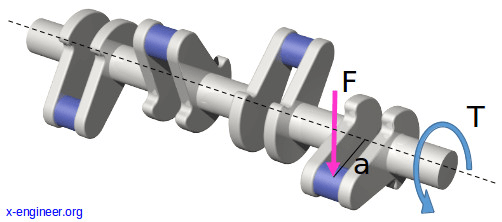
Image source: https://x-engineer.org/power-vs-torque/
To briefly mention torque in different types of engines, torque in diesel engines is higher than gasoline engines due to the fact that gasoline uses a spark plug for ignition whereas a diesel engine depends on the heat to ignite the fuel. The higher compression ratios for diesel engines characterizes the higher torque.
In electric vehicles, electric motors are needed to power the vehicle. The motor is characterized by too much torque and rpm (revolutions per minute) of a crankshaft, so the reducer has the job to decrease the rpm to create higher torque and create wheel efficiency. In hybrid engines, a control unit controls the electrical motors and internal combustion engine crankshafts. At low speeds, the electric motor provides most torque. At acceleration, both the motor and the engine have max torque. In cruising, engines provide most torque.
In terms of the relationship between horsepower and torque, torque is the amount of work an engine can perform whereas horsepower is how quickly the car can accomplish the work. Despite horsepower being calculated by torque, a vehicle may need high torque but not high horsepower.
There are other automotive performance measurements used by car enthusiasts throughout the world. But everyone agrees that horsepower and torque are the two most fundamental pillars of them all.
 Aiden's Car Blogs
Leave a comment